When I build a system, I give particular attention to user rights, roles and security configuration. Over time I have settled on an approach to roles and permissions that is flexible enough to adapt to almost any new system I take on.
The core of the model is hierarchy. There are leaders who sit above other members of a team, and team members who can act on entities inside the team. The set of actions available to each person is different, and that difference is the whole point: a role is not a label, it is a precise answer to "what may this person do, and to which entities".
It comes down to three moving parts kept separate:
- Identity - who the person is, and which team or organization they belong to.
- Roles - a named position in the hierarchy, such as admin, manager, or a plain member.
- Permissions - the concrete actions a role grants, resolved against the specific entities the person can reach.
Keeping those three apart is what makes the model portable. The permissions are expressed as a claim carried on the user's identity, so a request is authorized by reading what the identity already proves rather than by re-deriving it every time. Swap the entity names and the hierarchy depth, and the same structure fits a new domain without a rewrite.
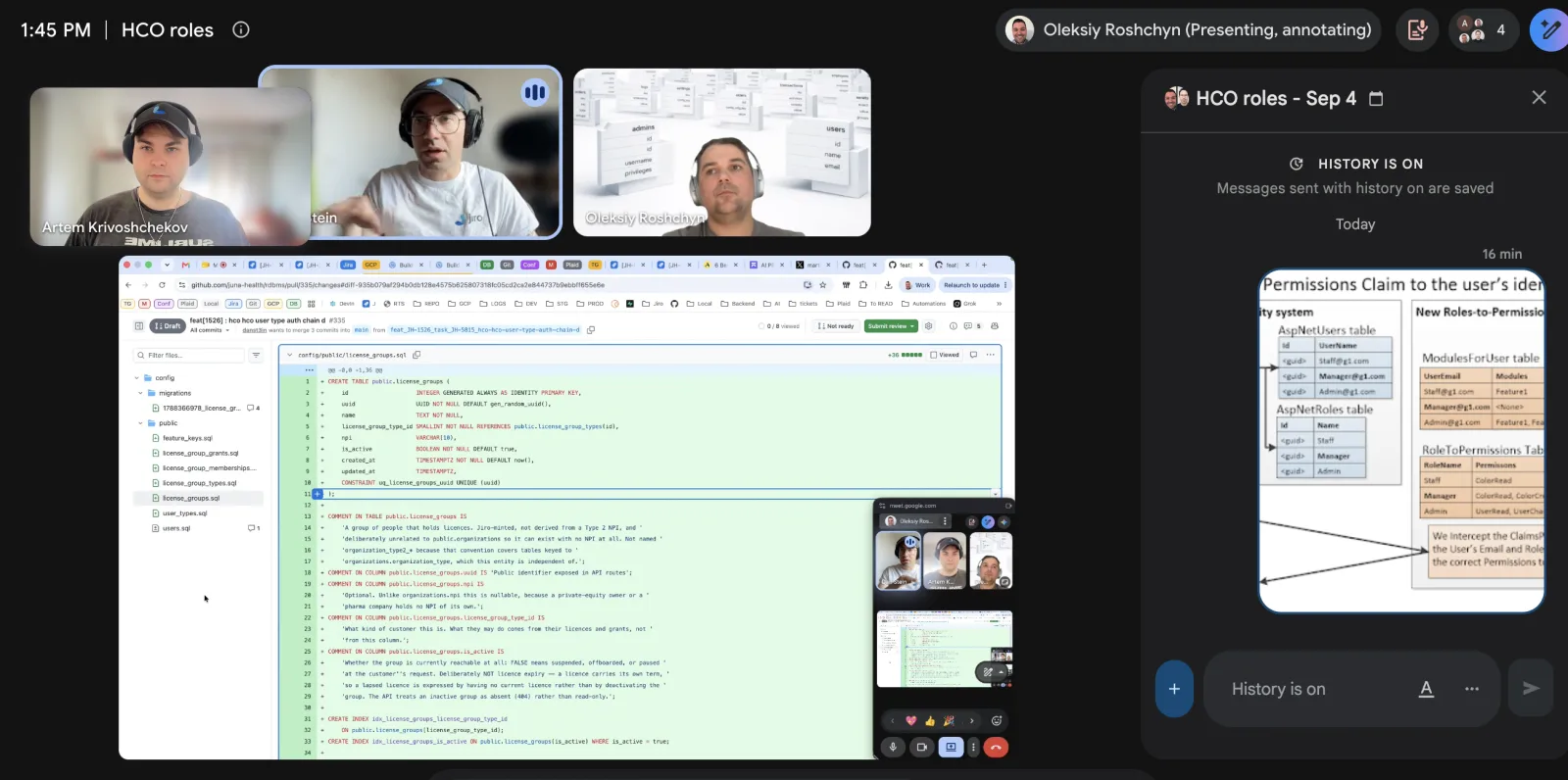
The last screenshot is from how the fit actually gets chosen. Together with the other engineers we got on a call, ran a brainstorm, and picked the authorization strategy best suited to that particular system, weighing its hierarchy and the set of actions each role needed. The model gives the starting shape; the brainstorm tailors it. That pairing is why the same approach keeps working across very different products.
The permissions in detail
The worked-out permission model for the system is below: the roles, the actions each one grants, and how they map to entities.
Table of Contents
Related
Projects

Jiro Health, Practice Intelligence for Clinicians
Before: US medical practitioners had to piece together income, referrals and cash flows from systems that were slow to integrate. After: as a principal/founding engineer I own API development end to end for my pods, building enterprise-grade interfaces on Node.js with Python background data processing.
Posts
Jiro Health Merch and a Photoshoot Under the Hospital de Clínicas Murals
The team at Jiro Health sent me branded merch. I live in Buenos Aires, so the place for the photoshoot, under the murals of the Hospital de Clínicas, almost chose itself.
My Professional Practice Presentation at Teclab
The recorded presentation of my Professional Practice at Teclab, done at Jiro Health on AppSec work, with the slides and the full speech script.
Vulnerability Fixer: Automated Dependency Remediation at Jiro Health
How an in-house pipeline at Jiro Health finds vulnerable dependencies across repositories, patches them safely, and delivers one reviewable fix PR with a Jira ticket and Slack summary.
Open for contract collaboration
I am available for contract-based collaboration. If you have an interesting project idea, schedule a call via Calendly.
Schedule a 30-min call