Ekoparty 2026 in Buenos Aires: Three Days of Security Talks in Photos
- Published on
- • 8 mins read•--- views
I spent 7, 8 and 9 October at Ekoparty Security Conference 2026 in Buenos Aires, the 22nd edition under the motto "Embrace the chaos". Three days, a main track, a dozen villages, and more talks on AI agents than on anything else. Here are the photos I kept and what was on the slides.
Main stage and installations
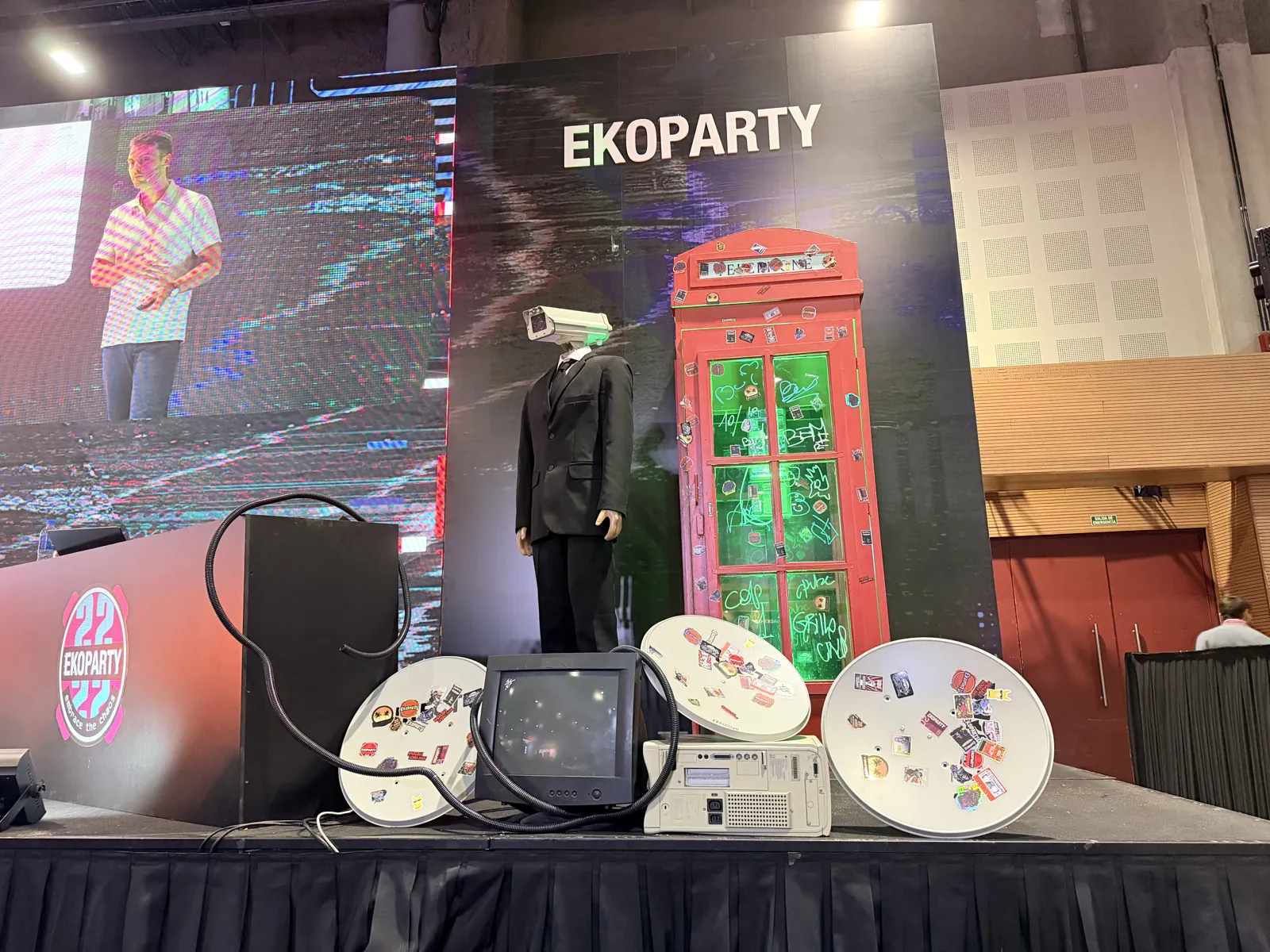
The main stage set the tone: a suit with a surveillance camera for a head, a red London phone booth plastered with stickers, and a CRT monitor wired to an old PC.
One installation was a mirror screen running a fake central surveillance system. It framed every passer-by, assigned a visitor number, a confidence score and a threat level, and printed the GPS coordinates of the venue. I was visitor 002, threat level low.
A thermal camera in a dark corridor did the same trick with heat instead of faces.
The AI security track
The talk I took the most notes on was "Zero Trust for AI Ops: Securing LLMs, RAG, and Agents" at the AI Resilience Hub village. The slides were in Spanish and every one of them had a one-line thesis.
"Guardrails do not bear loads." The pipeline goes preprocessing, context isolation, credential exchange, access decision, postprocessing. Identity travels as a SPIFFE SVID issued at runtime, and the residual risk line says it plainly: guardrails are defence in depth, never the boundary.
"The problem is the bearer model, not rotation." Any permission on an API key becomes live, because a goal-driven agent will eventually find a reason to use it. Possession is authority, and injection, exfiltration and disclosure are three delivery mechanisms for the same failure.
"OAuth authenticates the hop, not the authority." For MCP: authorization is optional, tool descriptions are read by the model and never by the user, and a bad OAuth setup turns the agent into a confused deputy. For A2A: agent cards are self-declared, nothing verifies delegated authority, and commitments travel as natural language.
The closing slide was practical. Start on Monday without spending money: inventory the agents and non-human identities in your environment, turn on policy logging in shadow mode, remove static secrets, apply query-time permissions against the requesting principal, log every prompt, retrieval and tool call bound to a human, and declare your egress isolation level.
The village also handed out this map of open-source tooling for agents and MCP: AgentBreak, MCP-SHIELD, PyRIT, Promptfoo, TruLens, Guardrails AI, OpenAI Evals, Giskard, Rebuff and LLM Guard, each with its use case. The footer is the point: no single tool is enough on its own.
At BlueSpace Village, David Soto, a.k.a. Jhere, talked about supply-chain attacks in the AI tooling ecosystem under the title "MCP and the problem nobody is seeing". His speaker slide carried the line that explains why: if I built it in a weekend, someone else is already running it in production.
Agents in practice
The GitHub workshop built an agentic pull request review on OWASP Juice Shop live: separate agents for adversarial testing, DevSecOps, quality and security testing, wired through MCP servers inside VS Code.
Their closing line: lead your agents the way you lead your team. Good communication holds the racing team together.
A demo screen in the hall walked through wiring Claude to Burp Suite through a Burp MCP server. The attacker does a first manual scan, the model decides which tool to call, the MCP server forwards send_request, get_http_history, base64_encode and create_repeater_tab, and Burp intercepts, stores and modifies the traffic.
Not everything was slides. One of the villages ran a sandbox of remote-controlled construction machines next to a model city.
Red team tooling
At Red Team Space, Santos Gallegos presented weaponAIzer, an agent pipeline for turning a CVE into a validated exploit. Eight stages: CVE research, an isolated Docker lab, attack planning by a red team agent, defence-in-depth gates reviewed by a blue team agent, controlled execution inside allowlisted containers, evidence collection, an independent judge, and a differential proof where the exploit must succeed on the vulnerable target and fail on the patched one.
The same architecture applied beyond CVEs: an agent reads a Patch Tuesday advisory, diffs the binaries, spins up an unpatched Windows lab and checks whether the patch closes the path or only moves it. On the CI/CD side, a research agent ingests every pull request, the red team tries to compromise the new surface, and nothing deploys until the judge signs off.
Main track
On the main track, Sammy Azdoufal walked through an audit of a camera vendor's cloud: a geolocation table of 825,194 rows and a P2P licence table of 1,160,795 rows, about 826,000 cameras plotted by WAN IP to where they physically are.
The talk was called "Nobody puts baby in a corner" and the full disclosure is public on GitHub under xn0tsa.
Zenity closed my list with "PleaseFix: how agentic browsers are undoing decades of security engineering". The title is the summary.
Closing
Swag of the year: a keychain made from an old RAM module next to the edition badge.
The closing ceremony on the main stage, with a team carrying the Fluid Attacks flag.
The attendance certificate, also on my About page:
Next year's edition is already in the calendar.
Related
Posts
From Teclab to Universidad Siglo 21: Continuing Towards a Degree in Information Security
With the Teclab professional practice presented, I transferred to Universidad Siglo 21 to continue towards the Licenciatura en Seguridad Informática, a distance programme.
My Professional Practice Presentation at Teclab
The recorded presentation of my Professional Practice at Teclab, done at Jiro Health on AppSec work, with the slides and the full speech script.
Vulnerability Fixer: Automated Dependency Remediation at Jiro Health
How an in-house pipeline at Jiro Health finds vulnerable dependencies across repositories, patches them safely, and delivers one reviewable fix PR with a Jira ticket and Slack summary.
Open for contract collaboration
I am available for contract-based collaboration. If you have an interesting project idea, schedule a call via Calendly.
Schedule a 30-min call